Reformer Pilates for Beginners: Everything You Need to Know Before Your First Session
Reformer Pilates became the second most booked fitness activity in the US in 2025, with bookings surging 84% year over year (ACE Fitness, 2025). If you've walked past a studio window and watched people sliding back and forth on those spring-loaded machines wondering what's actually happening in there, this guide is for you. From how the reformer works to what to wear, what to bring, and what your body will feel like afterward, this covers everything a first-timer needs before stepping into class.
Key Takeaways
- Reformer Pilates bookings surged 84% in 2024, rising to the #2 fitness activity in the US (ACE Fitness, 2025)
- A meta-analysis of 19 randomized trials (n=1,108) found Pilates significantly reduces chronic low back pain (PMC/NIH, 2023)
- Wear grip socks, and expect a 45 to 55 minute full-body workout
- Two to three sessions per week produces visible strength and flexibility gains within 6 to 8 weeks
- New Yorkers can start with a 1-on-1 reformer session or drop into a mat Pilates class at CompleteBody
What Is a Reformer Pilates Machine?
The global Pilates Reformer market reached $7.65 billion in 2025 and is projected to hit $16.8 billion by 2035, a 8.2% compound annual growth rate that reflects just how quickly this machine moved from physical therapy clinics into mainstream fitness studios (Future Market Insights, 2025). But what is it, exactly?
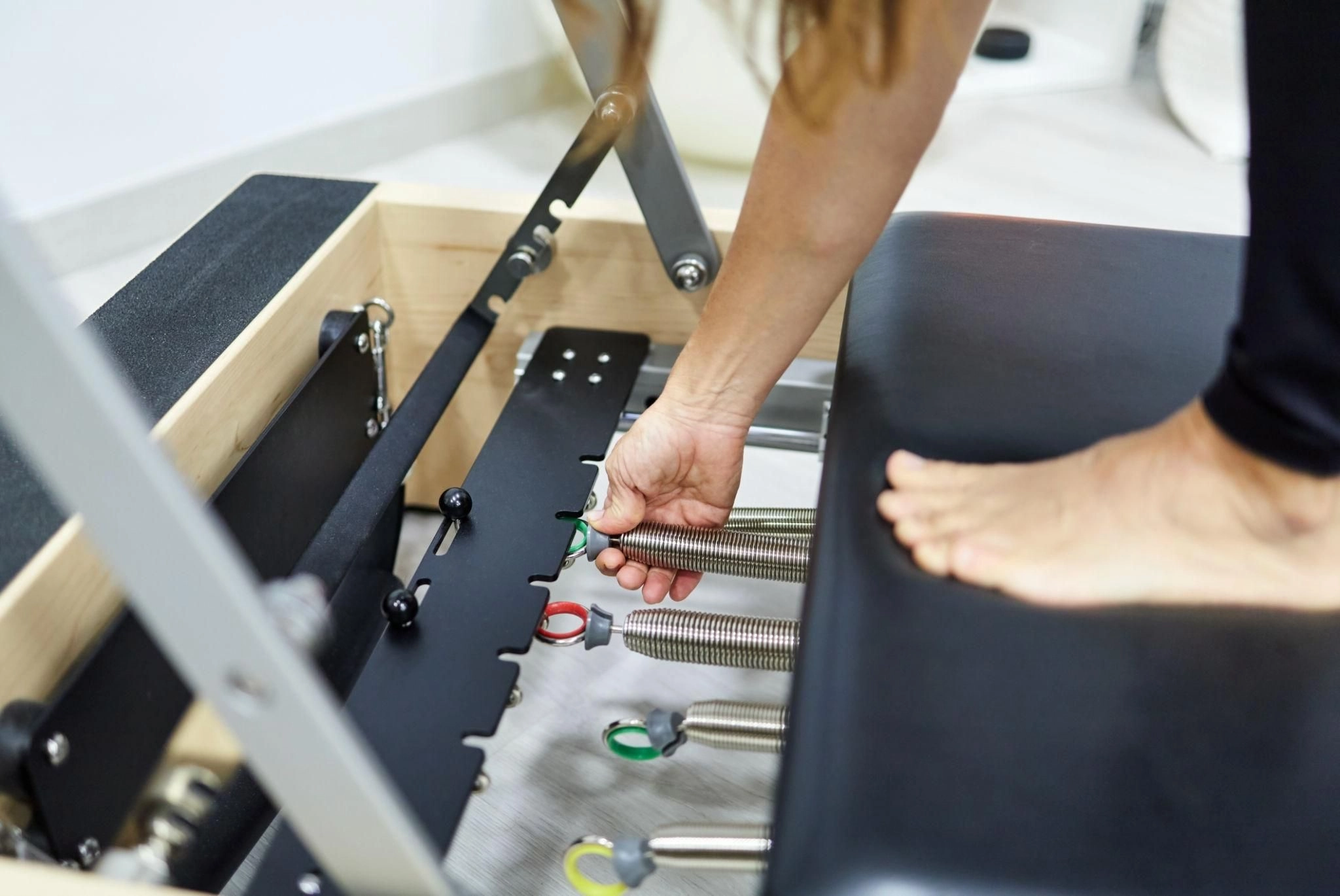
The Pilates reformer is a carriage-based resistance machine invented by Joseph Pilates in the early 20th century. It consists of a sliding carriage on a rail, adjustable coil springs that connect the carriage to the frame, a footbar you push against, and long rope-and-loop straps for your hands or feet. Those four components work together to create something no free weight or cable machine does: resistance that can simultaneously assist and challenge your body depending on the exercise and spring configuration.
Here's the part beginners find surprising. On a mat, you work against gravity alone. On a reformer, the springs can support your body weight to help you reach a position you couldn't hold otherwise, or they can add lateral, rotational, or horizontal resistance to load muscles that gravity never fully reaches. Your instructor adjusts the spring load for each exercise, which is why the same machine works for a post-surgical rehab patient and a competitive tennis player in the same class.
The carriage slides horizontally inside the frame, so most movements involve pushing off the footbar with your feet or pulling through the straps while your core stabilizes against the movement. This constant need to resist carriage motion is what makes reformer Pilates so effective at building deep stabilizer muscles that traditional gym training often misses entirely.
Worth knowing: The spring-driven load is eccentric and continuous rather than gravity-driven and ballistic. Joints move through their full range under constant tension rather than impact forces. This is a core reason Pilates carries one of the lowest injury rates of any resistance training method.
What Are the Proven Benefits of Reformer Pilates?
Clinical research from 2023 to 2025 confirms that Pilates produces measurable benefits across four health domains: back pain relief, core strength, flexibility, and mental health. Each benefit is now supported by peer-reviewed meta-analyses and randomized controlled trials, not just practitioner testimonials., 2023). That is a large clinical effect. For context, many pharmaceutical interventions for chronic pain don't achieve that threshold in randomized trials., 2023).
The reformer's instability demands deep stabilizers like the transverse abdominis and multifidus, muscles many gym-goers have never consciously loaded., 2024,, 2025). The focused, breath-centered nature of reformer Pilates appears to drive this through both physiological and attentional mechanisms.
Harvard Health also notes that Pilates is an excellent low-impact option for older adults and those returning from injury, because it builds body awareness that transfers directly to everyday movement patterns (Harvard Health, 2026).
What Does a 1-on-1 Reformer Session at CompleteBody Actually Look Like?
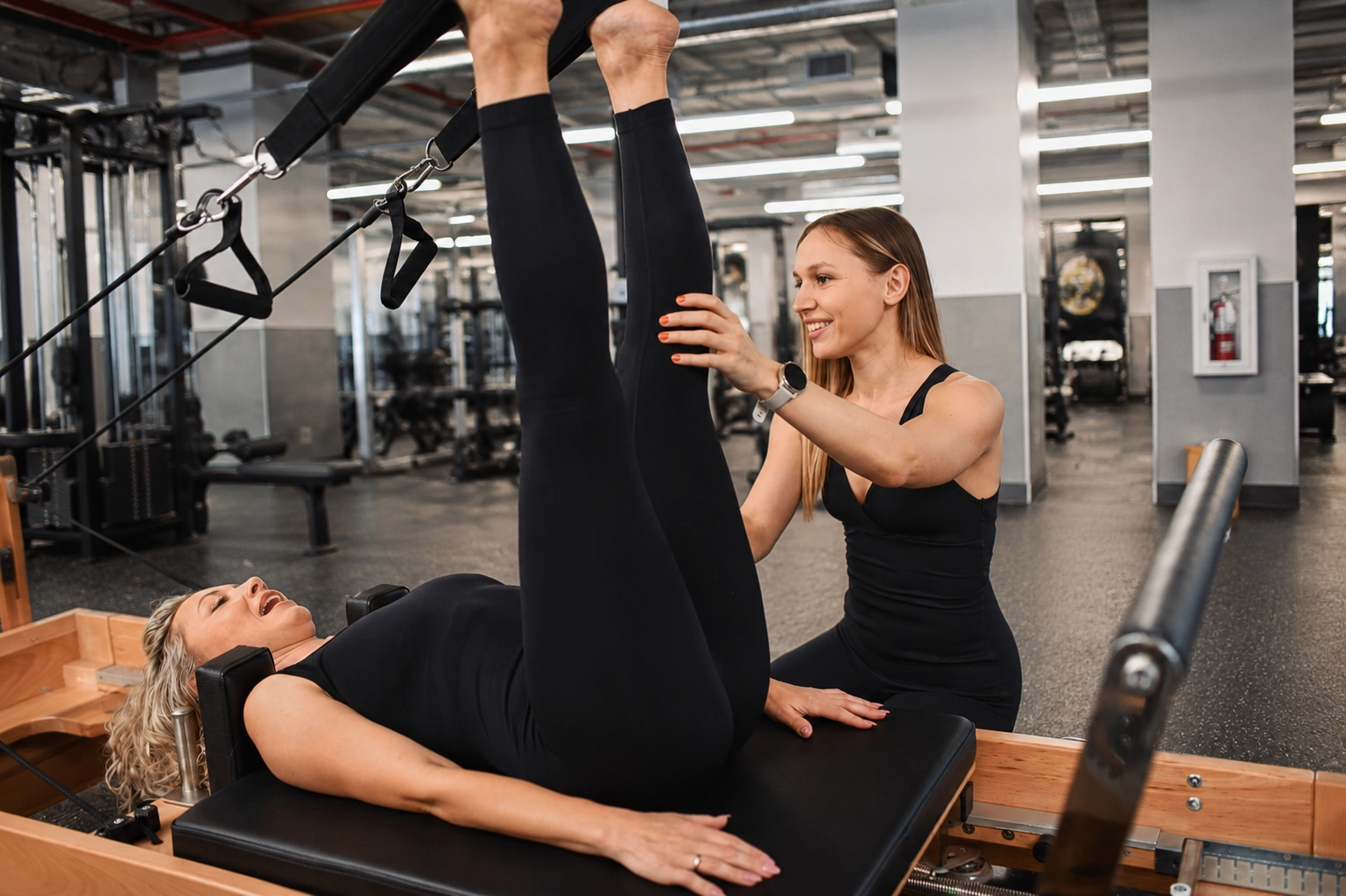
Most beginners don't know what to expect once they walk through the door, and that uncertainty is one of the biggest barriers to trying reformer Pilates. Here's an honest, step-by-step picture of what a 1-on-1 session at CompleteBody looks like so you're not navigating the unknown on your first day.
Your session begins with a full orientation. Your instructor will walk you through how the carriage slides, how springs attach by color-coded resistance level, and how to adjust the footbar for your height, with no time pressure and no group to keep up with.
Sessions typically open with footwork: lying on your back with feet on the footbar, pressing the carriage out and returning through several foot positions (heels, arches, toes). This warms up the ankles, calves, and hamstrings while giving you time to feel the spring resistance before more complex movements begin.
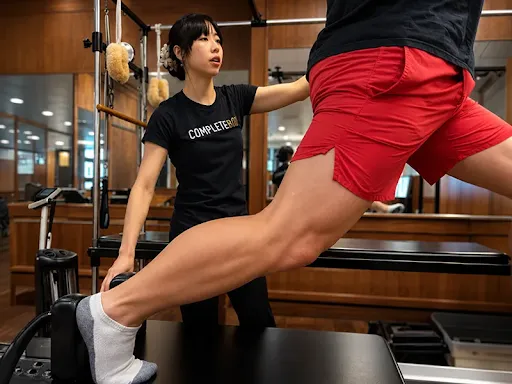
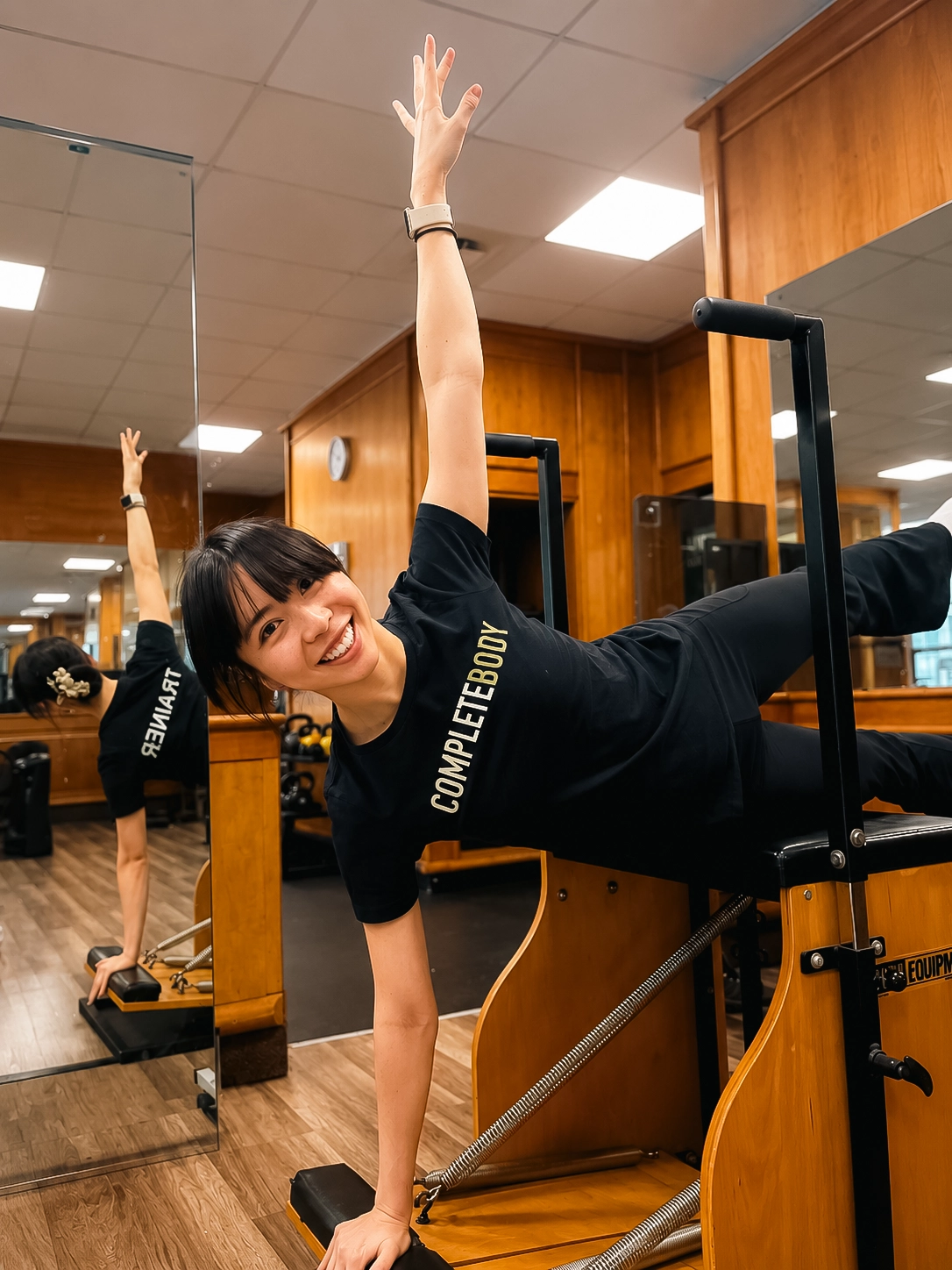
Your instructor will then move through exercises targeting core, legs, back, and shoulders in a deliberate sequence, adjusting spring load in real time based on how your body is responding. Common beginner movements include the hundred (supine arm pumping while maintaining a stable core), long stretch (plank position on the moving carriage), short box series (seated spinal flexion and extension with rotation), and mermaid (lateral stretch with side body opening). You won't know the names at first. Your instructor cues everything visually and verbally, so you follow them, not a memory bank.
Sessions close with stretching through the straps and footbar, typically moving through hip flexors, hamstrings, and thoracic spine. This is the most relaxing part of the session, and many beginners call it their favorite.
What our instructors consistently observe: Most beginners expect reformer Pilates to feel like yoga or a gentle stretch class. In a 1-on-1 session at CompleteBody, your instructor adjusts spring load in real time based on your response, but clients are still surprised to find their inner thighs, deep hip stabilizers, and serratus anterior shaking by minute 20. The springs look light. They aren't.
What Should You Wear and Bring?
With 25 to 30% of reformer Pilates class attendees now being men, up from roughly 10% just a few years ago, studio dress codes have evolved to accommodate a wider range of athletes and backgrounds (ACE Fitness, 2025). Still, a few basics apply to everyone on their first day, and knowing them in advance saves you from a confusing or uncomfortable start.
What to wear:
Fitted leggings or yoga pants (loose shorts bunch around the thighs during leg spring work and hip inversions)
A close-fitting top or tank (layered or oversized tops shift during plank-based movements and obstruct your view of your own alignment)
Grip socks with rubber dots on the sole (required at virtually every reformer studio for hygiene and traction on the carriage and footbar)
No shoes inside the studio
What to bring:
A water bottle (small enough to fit in the carriage cupholder or beside the machine)
A small towel (springs and footbars collect body oil over time, and most studios appreciate the courtesy)
Your phone on silent and out of reach (instructors need your verbal and physical attention during movements, and distractions during spring-loaded positions aren't a good idea)
Most studios sell grip socks for $15 to $20 at the front desk. You can also find them at most athletic retailers or online for less. Buy a couple pairs if you're planning to go regularly; they're a small investment for a piece of equipment you'll use every single class.
How Often Should Beginners Do Reformer Pilates?
Two to three sessions per week is the practical starting point for most NYC beginners, and research supports this as the minimum effective dose for meaningful change. The 2023 systematic review on core strength found that studies using higher weekly session frequencies produced stronger effect sizes than once-a-week programs. Consistency over intensity is the operative principle here.
Here's a realistic progression most beginners can follow:
Two sessions per week. Focus entirely on learning the machine, not on form perfection. Let your nervous system map the movements and spring tensions. Expect soreness in unfamiliar places.
Three sessions per week. You'll notice improved posture during desk work, better stability during other training, and reduced tension in your lower back and hips. These changes are early indicators that your stabilizer muscles are activating more consistently.
Three to four sessions per week, or complement your reformer sessions with CompleteBody's mat Pilates classes to vary the stimulus. At this stage you can begin targeting specific outcomes: athletic performance, spinal health, postural correction, or stress management.
Does reformer Pilates replace strength training? For most people, no. It complements it. If you're already lifting or working with a trainer, reformer Pilates addresses the stabilizer and mobility gaps that most barbell and cable programs underload. Pairing reformer sessions with personal training at CompleteBody gives you a genuinely complete program targeting both primary movers and stabilizing systems.
Is Reformer Pilates Right for You?
Women make up approximately 72% of US Pilates studio clients and the average practitioner age is 45, but the real story is how quickly the demographic is diversifying (Dojo Business, 2025). Reformer Pilates is genuinely appropriate for most fitness levels, including post-surgical patients, older adults, and people with no consistent training history. The spring-based resistance allows near-unlimited modification, so a person rehabbing a knee replacement and a marathon runner can each work at the right load for their body, and at CompleteBody, where all reformer sessions are 1-on-1, your instructor sets that load specifically for you.
Who benefits most:
People with chronic low back pain seeking a non-pharmaceutical intervention backed by strong clinical evidence
Desk workers with tight hip flexors, weak glutes, and poor thoracic mobility
Postpartum individuals cleared for exercise by their physician
Athletes looking to identify and correct movement asymmetries
Anyone who has plateaued in traditional gym training and needs a different stimulus
Who should consult a physician first:
People with acute disc herniations (several spinal flexion movements load the disc)
Anyone in the first six weeks after surgery
Individuals with severe osteoporosis (some extension loading may not be appropriate)
At CompleteBody, all reformer sessions are 1-on-1. Whether you're managing a complex injury history, returning to exercise for the first time, or working toward a specific performance goal, your instructor builds the session around your body from the first minute. No modifications to request, no group pace to keep up with.
A 2024 NIH study found that 12 weeks of Pilates mat-based work reduced medial knee displacement by 5.1 cm during running (p = 0.034), a biomechanical risk factor for ACL and patellofemoral injuries (PMC/NIH, 2024). This suggests Pilates may serve a meaningful injury-prevention role even for athletes with no current complaints, because it addresses the movement quality issues that typically precede injury.
How to Start Reformer Pilates in NYC
New York City has some of the highest reformer Pilates studio density in the country, which is good for access and price competition, but it also means the quality gap between studios is wide. Here's what to look for when choosing where to start. Look for teachers certified through a recognized program such as STOTT Pilates, Balanced Body, BASI, or Power Pilates, completion of a 450-plus hour certification program is the professional standard. Ask the studio directly before booking. At CompleteBody, all reformer sessions are 1-on-1, meaning you receive undivided instructor attention every session, no form habits quietly developing in the background.
Professional-grade Balanced Body or STOTT Pilates reformers cost $5,000 or more per unit. Studios cutting equipment costs are usually cutting instructor training costs, too.
Quality studios offer an introductory package or beginner series for people who've never touched a reformer. If a studio doesn't offer any introductory or private options, that's a warning sign.
CompleteBody offers group fitness classes and certified personal training across five Manhattan locations. The Midtown East location features a saltwater pool for recovery between sessions, a useful complement to the muscle soreness beginners feel in the first few weeks. The Financial District location includes a three-story rock climbing wall alongside its full fitness programming. The Chelsea location serves the West Side and is well-situated for members coming from the surrounding neighborhood. For commuters passing through Midtown, the Grand Central location is purpose-built for fitting a workout into a work schedule, and the Union Square location offers a Himalayan salt lounge for post-workout recovery.
Ready to see what the reformer actually feels like? Book your first 1-on-1 reformer session or drop into a mat Pilates class at CompleteBody and work with one of our certified instructors to find the right fit for your fitness level and goals.
---
Frequently Asked Questions
Is reformer Pilates good for complete beginners with no fitness experience?
Yes. The spring system can be configured to assist your body weight, making movements accessible for people who've never trained before. Harvard Health notes that Pilates is particularly well-suited for those new to exercise because it teaches body awareness and movement mechanics before loading the body heavily (Harvard Health, 2026). CompleteBody's reformer sessions are exclusively 1-on-1, so your first session is already built around your fitness level, movement history, and goals
How is reformer Pilates different from mat Pilates?
Mat Pilates uses body weight against gravity. Reformer Pilates uses spring resistance to both assist and challenge movement in ways gravity can't. The reformer enables a wider range of exercises, more precise resistance adjustment, and immediate feedback on alignment and symmetry. Most instructors recommend beginners try both; they address different aspects of core function and body awareness, and they're complementary rather than interchangeable.
How sore will I be after my first reformer Pilates class?
Expect delayed onset muscle soreness (DOMS) 24 to 48 hours after your first session, particularly in the inner thighs, lower abdominals, and muscles along the spine. This is normal and resolves within two to three days. It indicates that deep stabilizer muscles you rarely train directly were activated. The soreness typically becomes less intense after the third or fourth session as those muscles adapt.
How long before I see results from reformer Pilates?
Most beginners notice improved posture and reduced back tension within two to three weeks of consistent practice. Measurable strength and flexibility changes appear at the four to six week mark for most people. The 2024 randomized clinical trial showed significant flexibility improvements after a single structured Pilates program (PMC/NIH, 2024). The key variable is consistency, not session intensity.
Can I do reformer Pilates if I have chronic back pain?
In most cases, yes. The 2023 meta-analysis of 1,108 patients found Pilates produces a large, statistically significant reduction in chronic low back pain (PMC/NIH, 2023). Consult your physician or physical therapist first if you have an acute disc injury or recent spinal surgery. Once cleared, tell your instructor about your condition before class so they can modify loading and positioning appropriately throughout the session.
What's the difference between beginner and advanced reformer classes?
At CompleteBody, reformer sessions are 1-on-1 rather than group classes, so there's no beginner or advanced tier to navigate. Your instructor sets the spring load, movement complexity, and pace based on where you are that day. If you're also attending mat Pilates classes, your instructor can coordinate both to make sure they're working together toward the same goals.