Strength Training for Beginners A Complete Guide to Getting Started
Only 31% of American adults meet the federal guideline for muscle-strengthening activity, according to the CDC. That guideline is modest work every major muscle group at least twice a week. Most people never start because the weight room feels intimidating, not because the training is hard.
We coached hundreds of first-time lifters at CompleteBody over the past decade, and the pattern is always the same. The beginners who succeed aren't the strongest or the most motivated. They're the ones who start with a simple plan and show up twice a week minimum.
This guide gives you that plan. You'll learn how often to train, exactly what to do in your first workout, how fast results arrive, and the five mistakes that stall MOST new lifters.
Key Takeaways
• Two full-body sessions per week meet the evidence-based minimum set by the 2026 ACSM resistance training guidelines
• 90 to 120 weekly minutes of resistance training is linked to a 13% lower risk of early death (British Journal of Sports Medicine, 2026)
• Most beginners feel stronger within 2 to 4 weeks visible muscle changes typically appear between weeks 6 and 12
Why Should Beginners Start Strength Training?
A meta-analysis published in the British Journal of Sports Medicine found that 90 to 120 minutes of weekly resistance training was associated with a 13% lower risk of all-cause mortality and a 19% lower risk of cardiovascular death (PubMed, 2026). lifting weights twice a week is one of the highest-return habits you can build.
The benefits stack up beyond longevity. Strength training increases bone density, improves insulin sensitivity, and protects the joints that city life punishes knees on subway stairs, lower backs hunched at desks, shoulders rounded over phones.
And you don't need to choose between cardio and weights. The same research found that people who did both had up to a 45% lower mortality risk than people who did neither. If you already run or take group fitness classes, adding two lifting sessions multiplies what you're already getting.
Here's the part nobody tells beginners you're at the most rewarding stage you'll ever be. Untrained lifters adapt faster than anyone else in the gym. Every session produces measurable progress. Advanced lifters would trade a lot to experience those first twelve weeks again.
How Often Should a Beginner Lift Weights?
Two days per week. The 2026 ACSM resistance training guidelines, the first major update in 17 years, set the evidence-based minimum at two weekly sessions covering all major muscle groups, with 2 to 3 sets per exercise (ACSM, 2026). More is not better for a beginner. Consistent is better.
In our experience training hundreds of beginners, twice a week works remarkably well.
Muscles grow between workouts, not during them. Training a muscle, then giving it roughly 48 hours to recover, produces the adaptation. A Monday and Thursday schedule, or Tuesday and Friday, covers everything with room to spare.
Structure each session as a full-body workout rather than splitting body parts across the week. Full-body training means that even if you miss a session, every muscle still got worked that week. Body-part splits punish missed days, full-body plans forgive them.
The ACSM guidance also recommends holding this baseline for 8 to 12 weeks before adding a third or fourth day. Your muscles adapt quickly, but tendons, ligaments, and connective tissue need more time. Rushing frequency is how beginners end up with tendonitis in month two.
If you're not sure your schedule can support even two sessions, that's exactly the problem a personal trainer in NYC solves. A standing appointment turns "I should go" into "I have to be there at 7."
What Should Your First Strength Workout Look Like?
Start with five or six compound movements at 2 to 3 sets of 8 to 12 reps each, which matches the ACSM's recommended baseline volume for new lifters. Compound exercises work several muscle groups at once, so a short list covers your whole body in about 45 minutes.
Here's the exact template I give new clients
Goblet squat (legs, core) 3 sets of 10
Dumbbell bench press or push-ups (chest, shoulders, triceps) 3 sets of 10
Seated cable row or dumbbell row (back, biceps) 3 sets of 10
Dumbbell Romanian deadlift (hamstrings, glutes, lower back)2 sets of 10
Dumbbell shoulder press (shoulders, triceps) 2 sets of 10
Plank (core) 2 holds of 30 seconds
Pick a weight where the last two reps of each set feel challenging but your form stays clean. If you finish 10 reps and feel like you could do 10 more, go heavier next set. If your form breaks down at rep 6, go lighter.
Rest 60 to 90 seconds between sets. Beginners often rush this part. The rest is what lets you push hard on the next set, and effort per set matters more than total time in the gym.
Machines are a legitimate starting point, by the way. They guide your movement path while you're still learning what a rep should feel like. Plenty of my clients spend their first month mostly on machines, then graduate to dumbbells and barbells as confidence builds. The Mayo Clinic makes the same point proper form matters far more than which equipment you use.
How Fast Will You See Results?
Faster than you think, in one sense. Most beginners feel noticeably stronger within 2 to 4 weeks, because early strength gains come from your nervous system learning to recruit muscle more efficiently. Visible muscle changes usually follow between weeks 6 and 12 with consistent training, eating, and sleep.
Research on structured resistance programs in untrained adults has shown fat-free mass gains in the range of several kilograms over a few months.
One of my clients, a 34-year-old software developer who works near our Financial District location, couldn't do a single push-up in January. By April she was benching 65 pounds for sets of 8 and doing 12 clean push-ups. Nothing exotic happened. She trained twice a week, every week, and added a little weight when the sets felt easy.
That's the honest timeline
Weeks 1 to 2 Soreness, awkwardness, learning the movements
Weeks 2 to 4 Weights that felt heavy become manageable energy improves
Weeks 6 to 8 Clothes fit differently lifts are up 15 to 25%
Weeks 10 to 12 Visible changes in the mirror training feels like routine, not effort
What ruins this timeline?!?
Inconsistency!
Three sessions one week and zero the next two weeks resets your momentum every single time. Two sessions every single week beats any perfect program done sporadically.
This applies to diet too. Staying disciplined Monday through Friday, then undoing it over the weekend with heavy drinking and multiple cheat meals, cancels out the consistency you built during the week. The same principle that makes twice-a-week training work,regularity over intensity, applies to eating. A moderate, sustainable approach seven days a week beats a strict Monday-to-Friday plan followed by a weekend blowout.
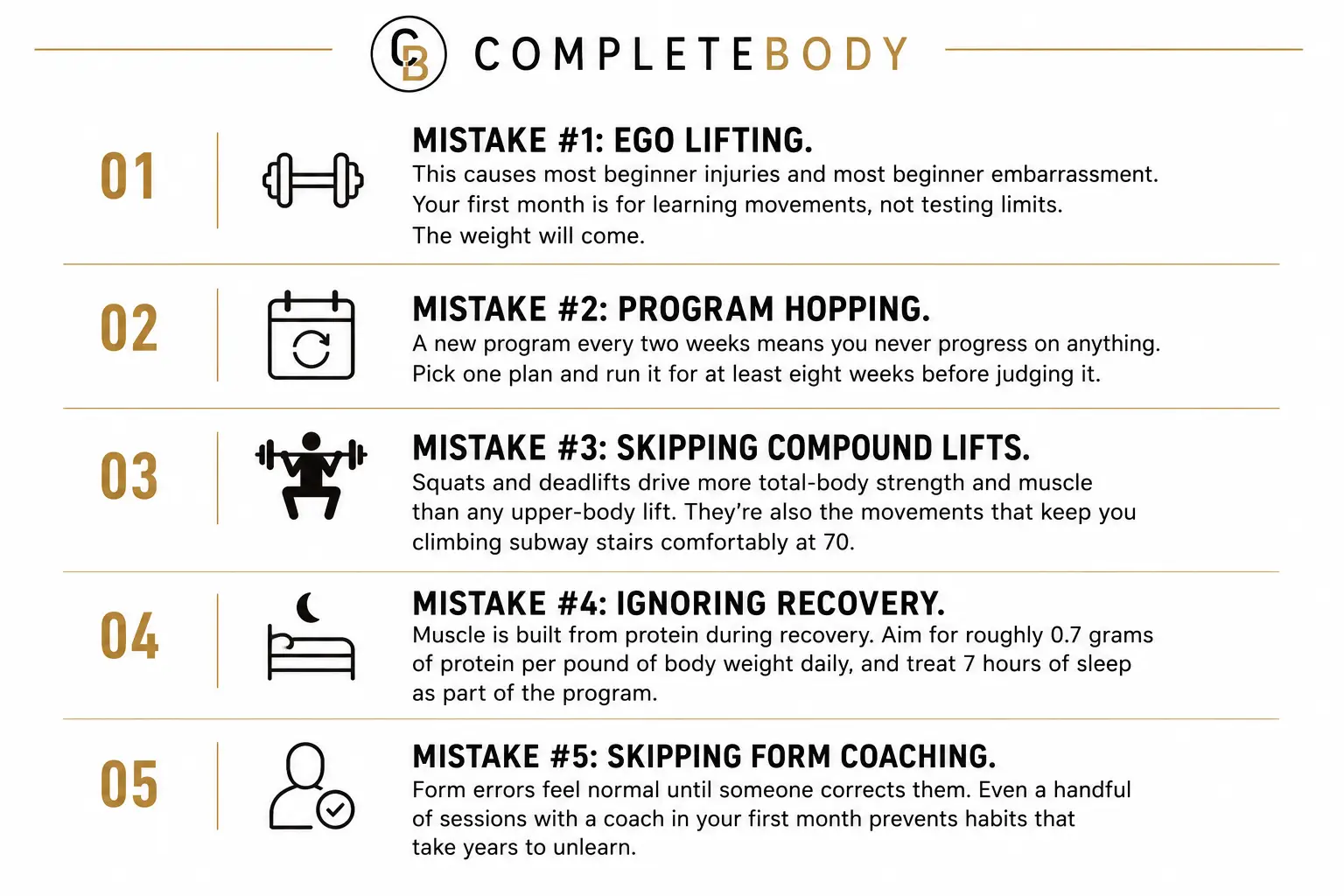
The Five Mistakes That Derail New Lifters
Most beginners don't quit because strength training failed them. They quit because one of five avoidable mistakes made the process miserable. After ten years of coaching, I can usually predict which one will bite a new client before their first session ends.
A beginner who avoids all five mistakes rarely struggles. In my experience, a new lifter who trains twice weekly, follows one program, and eats enough protein succeeds almost every time. The formula isn't complicated. It's just easy to skip.
Where Should You Start in NYC?
The best beginner gym is the one you'll actually get to twice a week, which in Manhattan means picking by commute, not by amenities. A gym two minutes from your office or train beats a nicer gym twenty minutes away, every single time.
CompleteBody's five Manhattan locations were placed around exactly that logic. If you commute through Grand Central, you can train before your train home and turn dead transit time into your two weekly sessions. Downtown, our Financial District club sits minutes from Wall Street offices and even has a three-story climbing wall for the days you want variety.
Serious about learning barbell work? Our Chelsea location has the deepest strength training floor in our portfolio, and the community there is welcoming to beginners in a way that surprises people who expect a bodybuilding gym to be intimidating.
Whichever gym you choose, ours or not, do one thing this week book your first two sessions in your calendar like meetings. You can try CompleteBody free at any location and use the workout template from this guide on day one.
Frequently Asked Questions
Can I start strength training if I've never exercised before?
Yes. The 2026 ACSM guidelines were written specifically to lower the barrier for inactive adults two sessions per week at 2 to 3 sets per exercise is the evidence-based starting point. Begin with machines or light dumbbells, and consider a trainer for your first few sessions to learn form safely.
Will lifting weights make me bulky?
No. Research on untrained lifters shows even intensive 12-week programs produce around 3 to 4 kg of lean mass in men, and less in women due to hormonal differences. Visible "bulk" takes years of deliberate training and eating. Beginners get firmer and stronger long before they get bigger.
How long should a beginner strength workout take?
About 45 minutes. Five or six exercises at 2 to 3 sets each, with 60 to 90 seconds of rest between sets, fits comfortably in that window. Total weekly time of 90 to 120 minutes is the range linked to a 13% lower risk of early death in the 2026 British Journal of Sports Medicine meta-analysis.
Do I need a personal trainer to start?
Not strictly, but the first month is when coaching pays off most. Form habits set early are hard to break later, and a standing appointment is the strongest consistency tool that exists. Many beginners do 4 to 8 trainer sessions to learn the fundamentals, then continue independently.
The Bottom Line
Strength training is the rare habit where the minimum effective dose is genuinely small two 45-minute sessions a week, six exercises, done consistently. Within a month you'll feel stronger. Within three months you'll see it.
Train your full body twice a week on non-consecutive days
Use 2 to 3 sets of 8 to 12 reps on compound movements
Add weight only when your form stays clean for every rep
Protect the habit with protein, sleep, and a fixed schedule